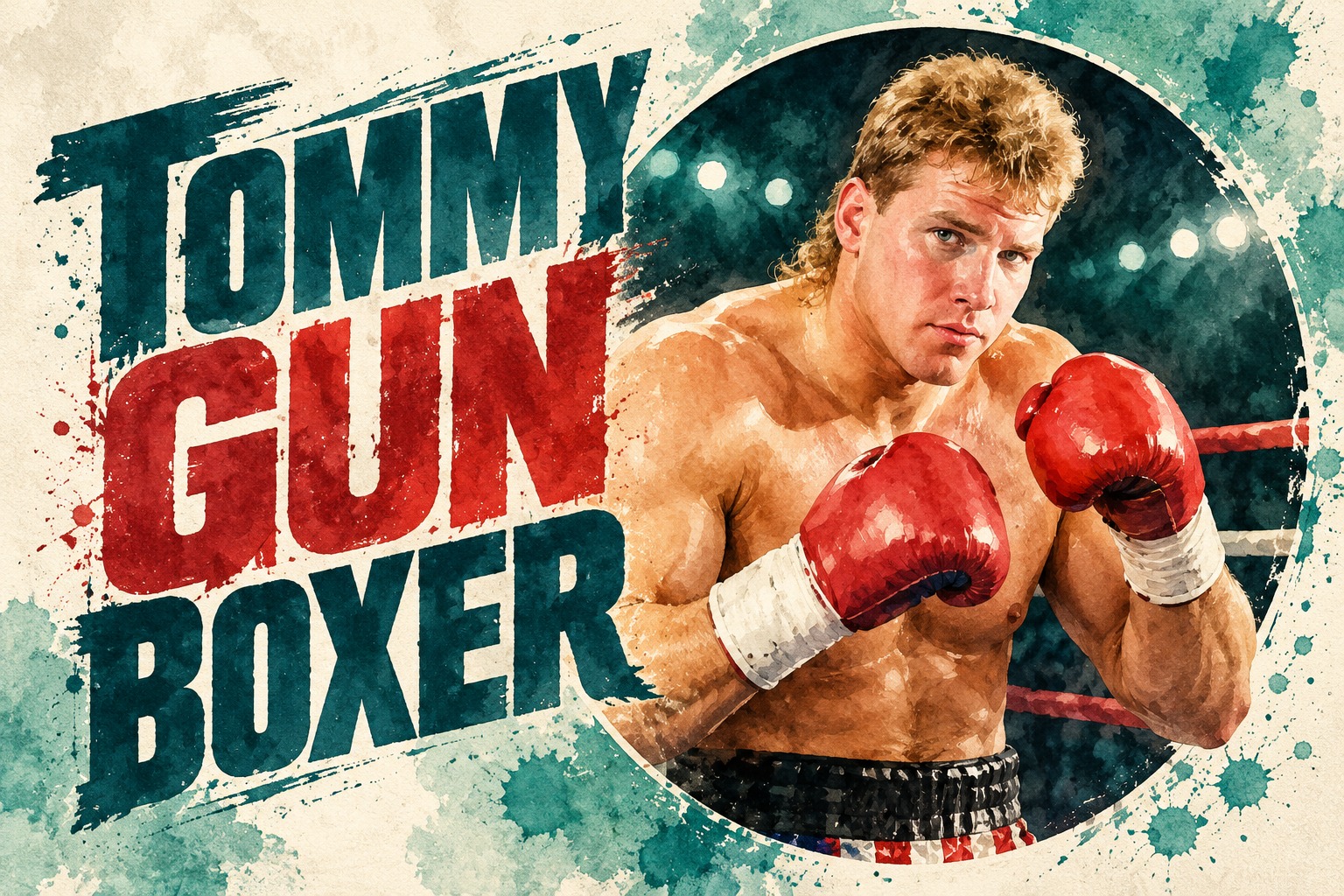
The fighter behind a screen character
The phrase Tommy Gun Boxer usually points toward Tommy Morrison and his role as Tommy Gunn in Rocky V. Morrison was a real heavyweight fighter, while Gunn was the fictional boxer he played in the 1990 film. I begin with that distinction because the character’s name can easily replace the athlete’s actual identity in casual searches and conversations.
Tommy David Morrison was born on January 2, 1969, in Gravette, Arkansas, and grew up in Jay, Oklahoma. He became professionally known as The Duke. His best established sporting milestone was winning the WBO heavyweight title against George Foreman in 1993, an achievement separate from his movie career.
Family roots in Arkansas and Oklahoma
Morrison’s parents were Tim Morrison Sr. and Diana Morrison, whose maiden name was Floyd. His mother’s background included Ponca and Otoe Native American heritage, while his father’s side was associated with Irish ancestry.
Tim introduced Tommy to boxing. An older half brother, Tim Morrison Jr., also had amateur boxing experience and connections with aspects of Tommy’s career. That detail gives the sport a place within the family’s life before Tommy became a nationally recognized heavyweight.
I do not make ancestry or family hardship into a mechanical explanation of how he punched. His roots identify his family background. The boxing record identifies the athlete’s results. Keeping those parts separate allows a fuller portrait without turning private experiences into an invented theory of fighting style.
Amateur boxing and the professional start
Tommy built an extensive amateur career before turning professional in 1988. Regional Golden Gloves success and a large number of amateur bouts gave him experience that preceded the rapid rise associated with his early professional years.
His professional debut took place on October 15, 1988, against William Muhammad, ending in a first round knockout. The result introduced a characteristic that remained central to Morrison’s public boxing identity: stopping power, especially through his left hook.
His final professional record is listed as 48 wins, three losses, and one draw, with 42 wins by knockout. I find those totals a useful measure of the career without needing to exaggerate his position among every heavyweight in history. They show both considerable success and a particularly high proportion of stoppage victories.
Rocky V and the name Tommy Gunn
In Rocky V, Morrison played Tommy Gunn, a young boxer whose relationship with Rocky Balboa forms part of the film’s story. The role brought him an audience beyond boxing and connected his appearance with a fictional narrative about ambition and loyalty.
The screen character should not be read as autobiography. A viewer may remember Gunn’s behavior more readily than Morrison’s real opponents, but the scripted choices belonged to the film. Morrison’s actual title win and ring record belong to sporting history.
I see the film as an additional strand of fame rather than a replacement for boxing. He was not an actor pretending to have a sporting background. He was a professional fighter who also performed in a major boxing movie, creating an unusually close overlap between the two identities.
The 1993 championship against Foreman
On June 7, 1993, Morrison defeated George Foreman by unanimous decision over 12 rounds and won the WBO heavyweight title. He was 24. The victory is the clearest high point of his professional boxing career.
It also complicates an image based entirely on quick knockouts. Winning a 12 round decision against a prominent opponent required a sustained performance over the championship distance. I regard that result as more informative than a highlights reel containing only his most explosive punches.
Later in 1993, he lost the title to Michael Bentt. His career continued, including a 1995 victory over Donovan Ruddock for an IBC heavyweight title. These results show a career with reversals and recoveries rather than a single climb ending at the Foreman fight.
The interruption in 1996
In 1996, a publicly reported positive HIV test interrupted Morrison’s boxing career. Later years included disputes about the test and attempts to return to competition. His public identity increasingly involved the difficulties of resuming a career that had previously been built around regular fights and major championship opportunities.
The professional consequence is clear enough for a boxing biography: the interruption changed the direction of his career at a time when he was still a relatively young heavyweight. His later attempts to compete did not restore the same sustained championship trajectory.
I also keep medical disagreement separate from ring achievement. The Foreman victory remains an actual sporting result, and the later health difficulties remain a different chapter. Neither requires a sensational account of his private life.
Trisha and three sons
Morrison married Trisha Harding on May 7, 2011. She became part of his later family story and has participated in preserving and discussing his memory. His three sons are Trey Lippe Morrison, James McKenzie Morrison, known as Kenzie, and Tristin Duke Morrison.
Trey pursued professional heavyweight boxing and made his professional debut in 2014, after his father’s death. Kenzie also developed a fighting career, with boxing and later bare knuckle competition among the identified activities. Tristin has a much lower public profile.
I regard the sons’ sporting choices as their own careers. A famous father creates a recognizable comparison, but the son’s opponents, results, and decisions must be evaluated individually. Trisha Harding should also be distinguished from Trisha Lippe, the name connected with Trey’s maternal background.
Death and later family attention
Morrison died on September 1, 2013, at 44. Later attention has centered on his championship fights, his film role, and the activities of his sons. Kenzie’s bare knuckle success in 2025 provided one example of the family name returning to sports coverage.
For me, the strongest account keeps three identities in view: Tommy Morrison the heavyweight champion, Tommy Gunn the fictional character, and Tommy the father whose sons later entered combat sports. The connections are real, while the achievements and stories remain distinct.
FAQ
Is Tommy Gun the boxer’s real name?
The real boxer was Tommy David Morrison, professionally known as The Duke. Tommy Gunn was the character he portrayed in Rocky V. The phrase Tommy Gun Boxer commonly combines that fictional name with Morrison’s real sporting career.
What was his biggest championship win?
He defeated George Foreman by unanimous decision on June 7, 1993, winning the WBO heavyweight title. The fight lasted 12 rounds and remains the central championship milestone in his professional record.
Which of his sons became fighters?
Trey Lippe Morrison and Kenzie Morrison pursued fighting careers. Trey entered professional heavyweight boxing, while Kenzie has been associated with boxing and bare knuckle competition. Tristin Duke Morrison is also identified as a son but has maintained a less public profile.


